
Independent sourcing partner

Solar PV inverter manufacturers for your sourcing brief

GridLink Sourcing writes the buyer requirement for string, central or module-level conversion, then asks proposed plants to answer the same rated AC power, DC input range and destination. A family name is not a model, and a brochure is not a datasheet for the quoted item.

Build a Sourcing Brief
Procurement desk with an inverter single-line sketch and an open bill of materials
  • Modules pairing
  • Inverters
  • Storage interface
  • Balance of system
Rated AC power
kW or MW the quote must state
DC input range
voltage window, not a marketing band
MPPT channels
count and whether inputs are paralleled
Open items
listing, protocol and lead time still blank
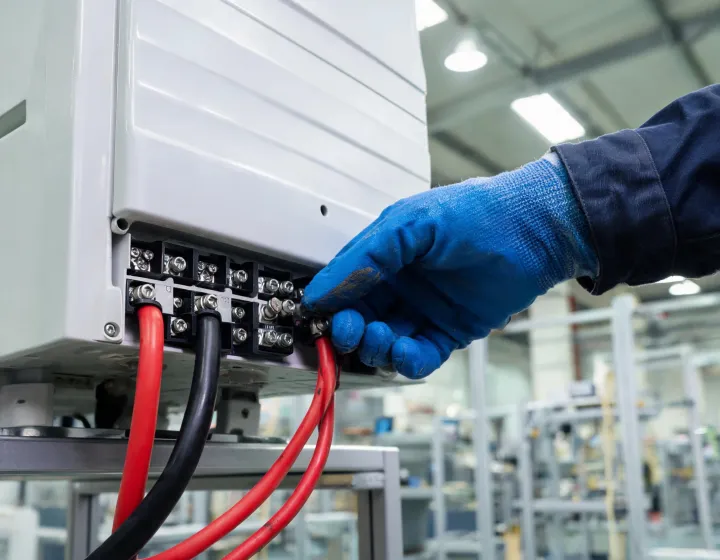
Technician pointing at DC input terminals on a commercial inverter

Put the electrical window on the request

Ask the plant to name rated AC power in kW, the DC input range in V, and the maximum system voltage required by the project. Record phase separately as single-phase, split-phase or three-phase, then state the site grid voltage and frequency. Values such as 208 V or 480 V at 60 Hz are examples only, not the assumed project rating. Compare module-string maximum power voltage and cold-condition open-circuit voltage against the proposed inverter's operating and absolute input limits.

MPPT channel count changes how strings are grouped. A later drawing that parallels inputs is a deviation, not a silent match. String current limits should be copied from the proposed datasheet, not from a neighboring power class.
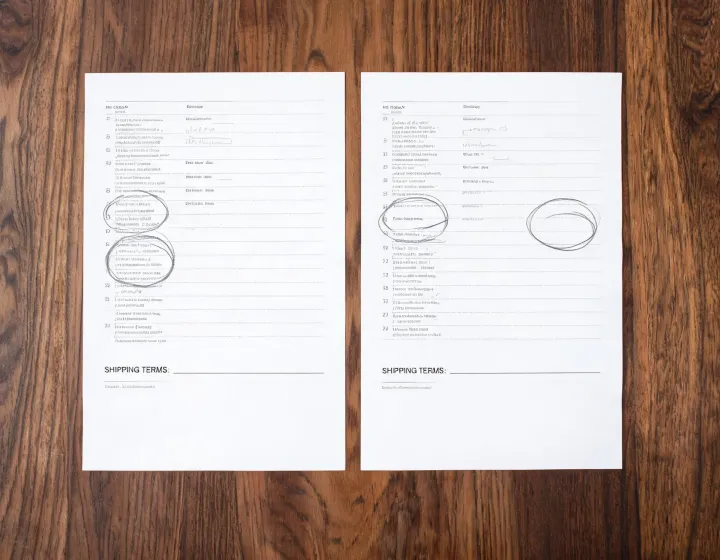
Side-by-side quotation sheets with accessory lines highlighted

Read unit price only after the scope matches

One camp treats the lowest unit price as the award signal when the equipment list truly matches. The other camp reads freight, taxes, DC connectors, monitoring dongles, warranty basis and commissioning boundaries first, because a thin price often omits them. GridLink Sourcing keeps both views on the sheet and does not publish a savings figure.

Currency, per-unit or whole-order budget, and a high-end, mid-range, budget or undecided supplier preference can travel with the brief. That preference is the buyer speaking, not a grade we verified.

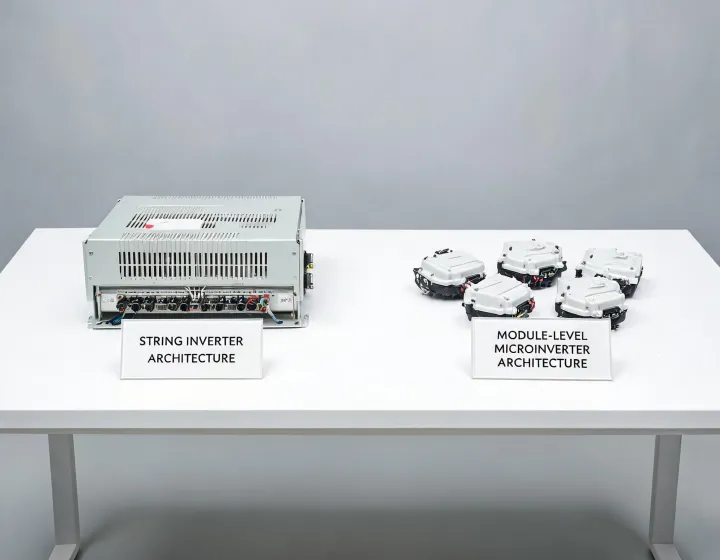
String inverter cabinet beside a module-level device on a workbench

Architecture is a project choice, not a slogan

Compare central or string conversion with module-level conversion using shade exposure, equipment count, service access and monitoring needs. Ask how the proposed system addresses rapid shutdown rather than assuming that an architecture proves compliance. The project engineer supplies the DC-to-AC ratio; this desk does not set a target or predict output.

Continue with the commercial pv inverter cards, the manufacturer matching steps, or the procurement brief.

Five project contexts, still without a finished design

Each card names the application, the interface question and the RFQ unit. None of them is a completed reference project.

Commercial rooftop

Application: commercial rooftop. Interface question: confirm the service voltage and phase from the single-line diagram; roof loading and setbacks remain with the responsible reviewers. RFQ unit: inverter count, with spares separate.

Ground-mount block

Application: row length and DC homeruns. Interface question: whether 1500 V DC strings are actually in the electrical study. RFQ unit: skid or inverter station, written as separate lines.

Storage pairing

Application: new PV plus batteries, or a retrofit beside an existing inverter. Interface question: compare AC-coupled and DC-coupled energy paths, voltage limits, controls and supported operating modes on the proposed diagram. RFQ unit: hybrid inverter or separate storage converter, with battery scope on its own line.

Fleet and site charging

Application: a canopy PV system that shares a service with chargers. Interface question: which party owns the interconnection study. RFQ unit: PV inverter only, with charger power listed as a site constraint rather than as this product.

Distributed energy room

Application: several buildings on one campus meter. Interface question: communication protocol and whether a SCADA point list exists. RFQ unit: one line per inverter rating so alternatives cannot hide inside a package price.

Questions buyers ask before the first call

Ratings

Which AC and DC numbers have to be on the quote?

Rated AC power, DC input range, MPPT channels, phase and grid voltage. Do not copy a catalog maximum into the requirement. Leave the cell blank and say it is unknown.

Does a DC-to-AC ratio travel with the RFQ?

Only when the buyer or the engineer of record already calculated it. The desk can ask the plant to confirm the ratio it assumed. It does not set 1.20 or 1.40 as a rule.

Documents

What file is tied to the exact proposed item?

The current datasheet and the dimensional drawing for the quoted model. A family brochure, an ISO 9001 leaflet, or an unrelated UL file is a request to verify, not evidence already in hand.

Who checks enclosure and environment?

Ask for the enclosure rating the supplier claims, such as a NEMA 3R or IP65 statement, plus the operating temperature range on that same model. Installation suitability stays with the qualified reviewer.

Commercial comparison

Can two prices be lined up on day one?

Only after quantity, currency, accessories, freight, taxes, warranty basis and exclusions use the same columns. A lower headline without those columns is not comparable.

Where do budget and supplier preference go?

Give an optional amount or range, currency, and per-unit or whole-order basis. High-end, mid-range, budget or undecided records the documentation, customization and service trade-offs you want compared. It is a buyer preference, not a verified supplier grade.

Figures a brief can carry without treating them as measured results
FieldExample the buyer may already know
rated power25 kW, 50 kW or 100 kW nameplate
maximum power voltage370 V or 650 V from the module string
open-circuit voltage450 V or 800 V at the cold-site cell temperature
string current12 A or 18 A per input
maximum system voltage1000 V DC or 1500 V DC
DC-to-AC ratio1.15, 1.25 or 1.35 if an engineer already set it
enclosure ratingquestion for NEMA 3R or IP65, not a pre-checked label
cycle lifeonly if a battery line is actually in the same purchase

Hand the brief to the desk when the blanks are honest

Quantity, US destination and the delivery window you hope for are enough to start a factory inquiry. Missing ratings stay visible instead of being filled with guesses.